For the complete documentation index, see llms.txt. This page is also available as Markdown.

Workflow builder

The canvas where workflows are designed, published and watched: header, palette, inspector, panels and run view

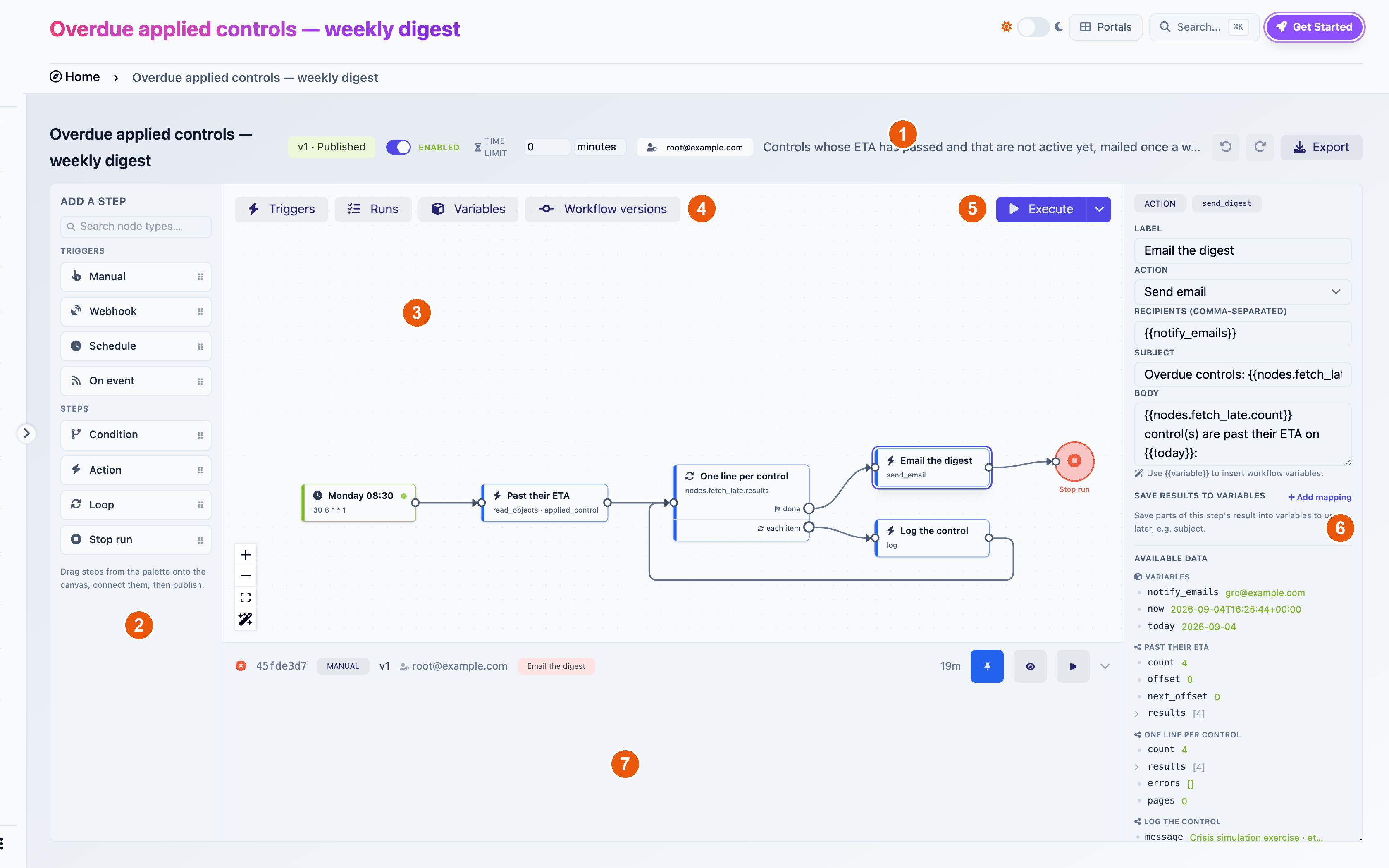
Open any workflow from Operations > Workflows and you land in the builder. Everything about a workflow happens here: designing the graph, configuring steps, publishing, enabling triggers, watching runs.

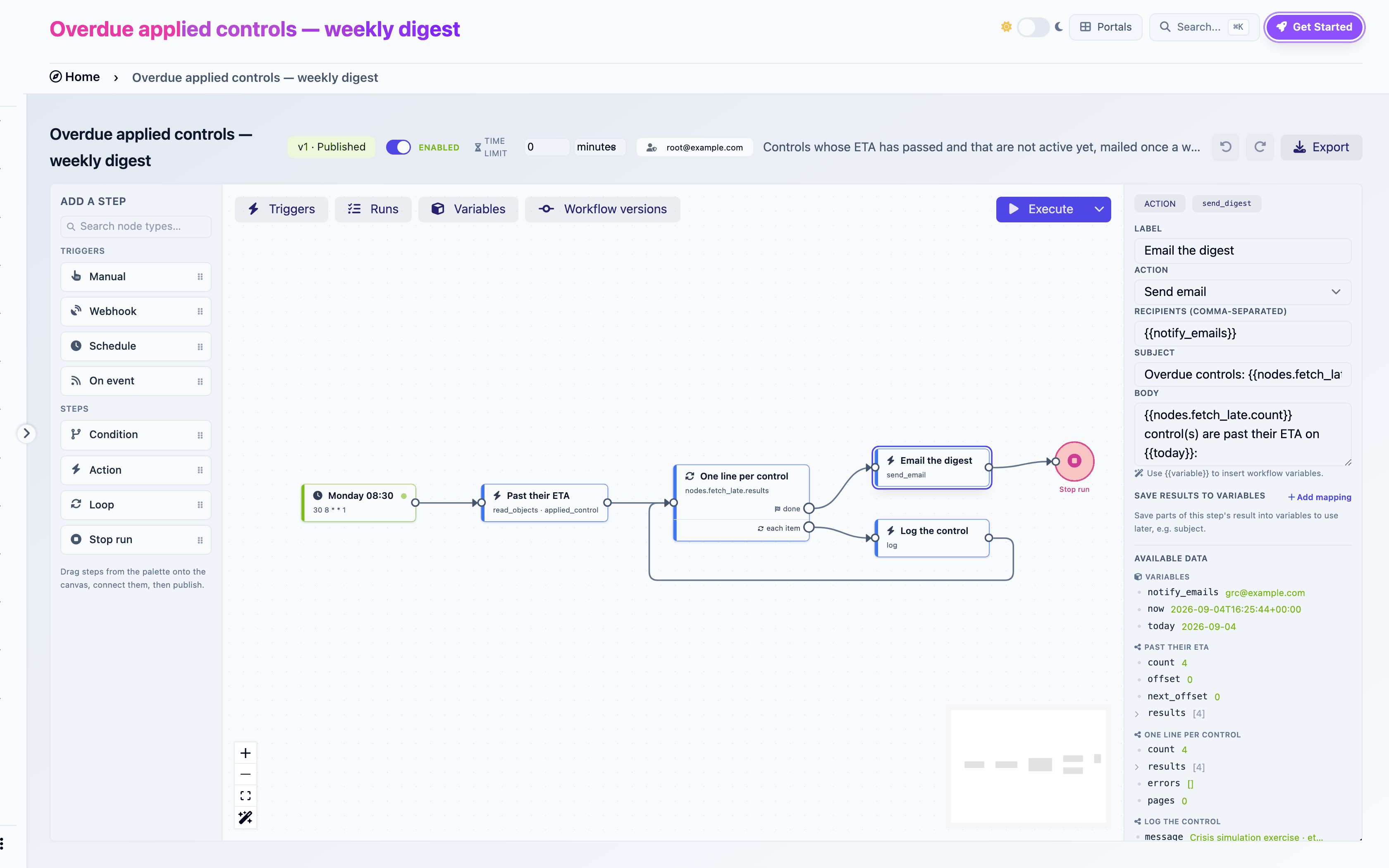
The builder: 1 header, 2 palette, 3 canvas, 4 panel toggles, 5 Execute, 6 inspector, 7 bottom panel (here, Runs)

The header

From left to right:

Element
What it does

Name and version badge

v3 · Published, v4 · Draft or v1 · Archived

Enabled / Disabled switch

The workflow's master switch. Off pauses every automatic trigger. Manual runs keep working so a paused workflow stays debuggable

Time limit

Maximum duration of a run, in seconds, minutes or hours. 0 means no limit. Runs that exceed it are stopped. Applies to runs already in flight

Run-as chip

The user whose permissions this version's runs use, with the tooltip "Runs as ...". An amber No run-as user badge means the version must be republished

Saving… / Saved

Autosave state. A red message means the last save failed. Click it to retry

Undo, Redo

Fifty steps of history. Edits made within under a second coalesce into one

Export

Downloads the workflow as a file you can import elsewhere. See Sharing

Discard draft

Deletes the draft and shows the published version again. Only when both exist

Publish

Runs the checks and publishes the draft. Only on drafts

Autosave and drafts

Every change is saved as you make it. There is no save button.

Editing a published version does not modify it. Your first change creates a new draft, the badge flips to Draft, and the published version keeps running untouched. Undo still walks back through the edits you made. Discard draft throws the draft away.

Versions panel

Workflow versions, in the top-left toggles, lists every version with its status, publication date, run-as user and run count. Click Restore as a new draft on an archived version to bring it back. This is blocked while a draft exists, so discard or publish that draft first.

The palette

The left rail, headed Add a step, lists what you can put on the canvas. Click an item to add it, or drag it where you want it. The search box filters by name.

Triggers

Item
Starts a run when

Manual

Someone clicks Execute

Webhook

An external system posts JSON to the trigger's URL

Schedule

A cron expression fires

On event

An object is created, updated or deleted in CISO Assistant

Steps

Item
Does

Condition

Picks exactly one branch based on variable values

Action

Does one thing: read, create, update, email, HTTP request, and so on

Loop

Runs its body once per item of a list, or once per object of a paged read

Stop run

Ends the whole run immediately

A workflow can hold one Manual trigger and any number of other triggers. All four trigger kinds and all step kinds are described in Triggers and Steps.

The canvas

Drag steps to arrange them. Drag from a step's output handle to another step's input handle to wire them. Hover a wire and click the × to delete it. Hover a step and click the red to delete it, or select it and press Delete. Deletions are immediate, and undoable.

Zoom with the mouse wheel or the controls in the bottom-left. The extra wand button there is Tidy up: it lays the whole graph out left to right. Tidy up is undoable.

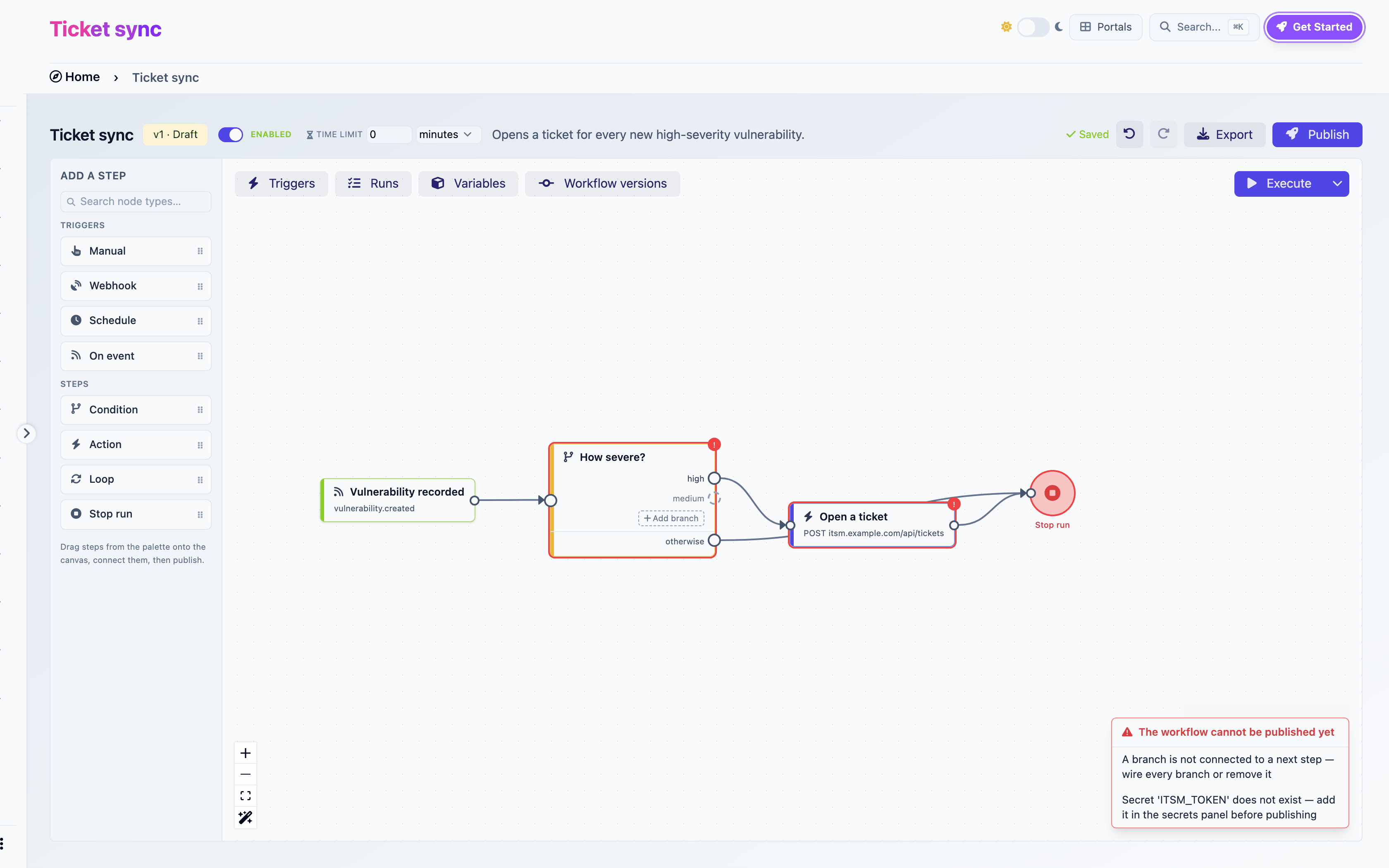
Selected steps get a ring. Steps with a publish error get a red ring and a red ! badge whose tooltip is the error.

Panel toggles

Four buttons in the top-left of the canvas open a panel at the bottom:

Toggle
Panel

Triggers

The state of every registered trigger: enabled or disabled, next run, last result, webhook URL. See Triggers

Runs

Every run of this workflow, live. See Runs

Variables

Declared variables and secrets. See Variables and secrets

Workflow versions

The version history

Execute

The Execute button in the top-right starts a run of the version you are viewing. The chevron next to it opens Run with variables, which lets you override variable values for that run only. If the workflow has several triggers and none is Manual, Execute asks you which trigger to start from.

When the workflow is disabled, an amber Paused badge sits next to Execute. Execute still works.

The inspector

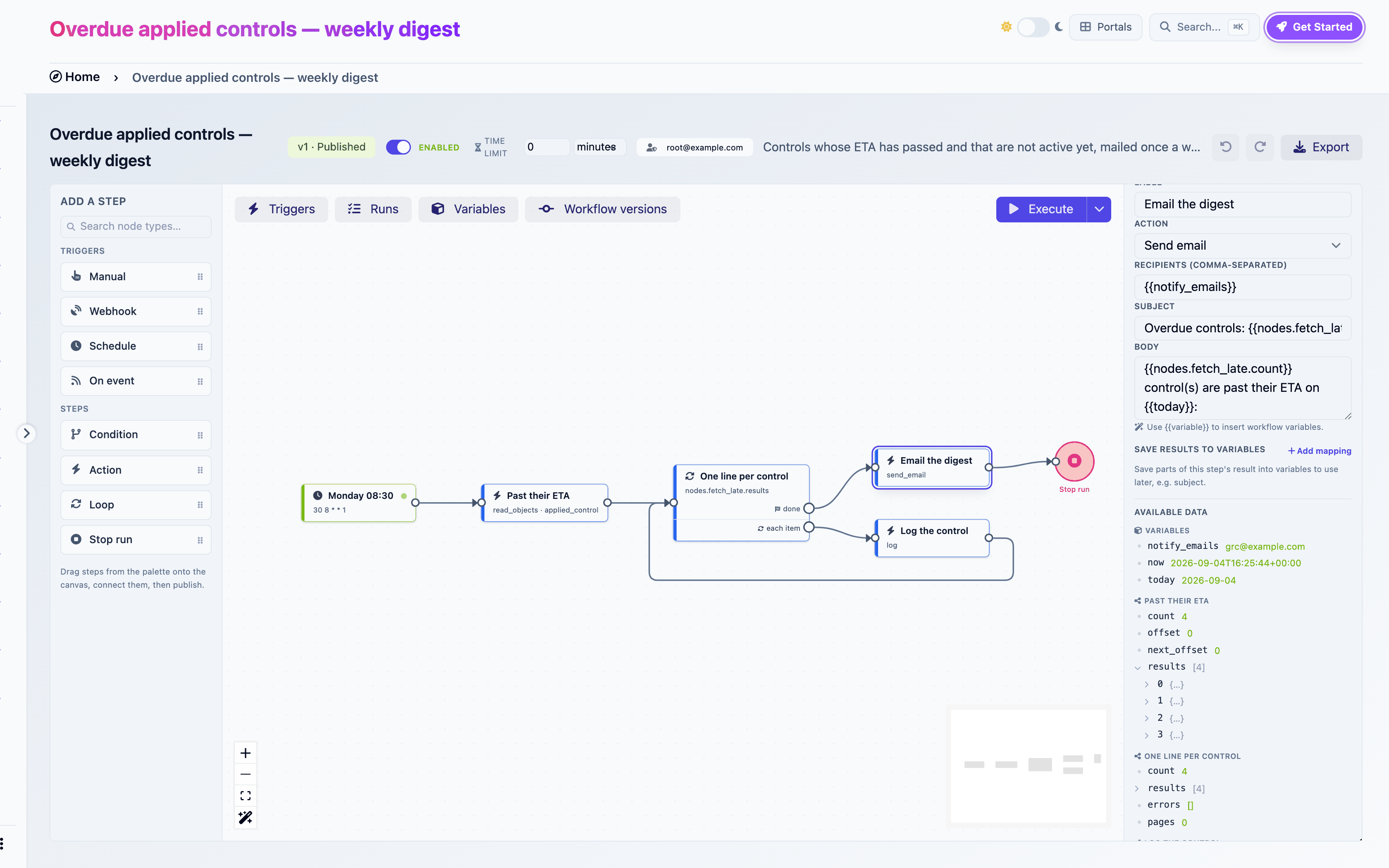
Select a step and the right rail shows its settings. Its top row carries the step type, the trigger kind for triggers, and the step's ref in monospace. The ref is what other steps use to reference this one, as in {{nodes.past_their_eta.count}}. It is derived from the label and follows it when you rename the step. Every reference elsewhere in the workflow is rewritten at the same time.

The inspector for an action step

The inspector's contents depend on the step type. Two blocks appear on most steps:

Save results to variables. Copies parts of the step's output into workflow variables once it has run. Each row is a variable and a path into the output, such as created_object_id, count or body.summary. This is how a value becomes available to a Condition step, which compares variables.

Available data. A browser of everything you can reference from this step: the current loop item, the variables, the output of every earlier step, the secrets. When a reference run is pinned, it shows the real values from that run. Click a value to insert its expression into the field you were editing. A Preview line renders the expression under your cursor with reference data. With no run yet, it reads "Run this workflow once to browse its real data here."

The Available data browser

Selecting a wire shows a small panel with an optional label. Wires leaving a Condition step are configured on the Condition itself.

Publish

Publish saves, then checks the graph, then asks you to confirm the permissions the workflow will exercise in your name: "Once published, this workflow runs as you, using these permissions:" followed by the list. Confirm and the version becomes Published.

If a check fails, nothing is published. A panel titled The workflow cannot be published yet appears bottom-right with one line per problem. Click a line to jump to the step. Every message is listed in Publish checks.

Publish checks failing

Run view

Click Show on canvas on a run and the canvas paints that run over the graph: visited wires turn green and animate, visited steps get a green check, a failed step a red ring, a step that completed with per-item errors an amber !. Loop steps show how many iterations ran. Replay steps through the run at a readable pace. A chip at the top shows the run id. Click its × to exit run view.

Keyboard shortcuts

Keys
Effect

⌘Z, Ctrl+Z

Undo

⇧⌘Z, Ctrl+Shift+Z, Ctrl+Y

Redo

Delete, Backspace

Delete the selected steps or wires

Enter, Escape

Confirm or cancel the inline variable creator

C (on the list page)

New workflow

Undo and redo are suppressed while a text field has focus, so text editing keeps its own undo.

The list page

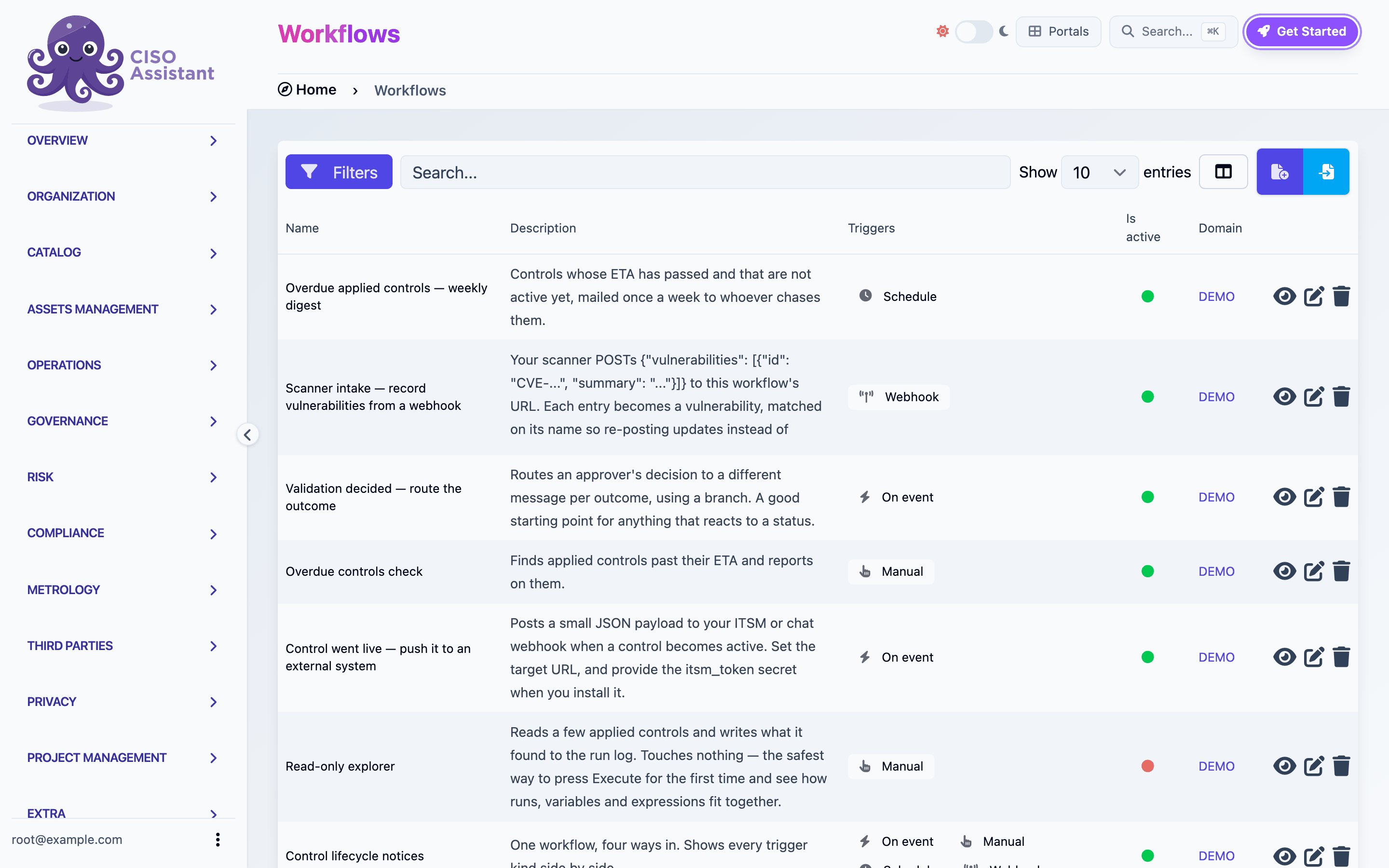
Operations > Workflows lists every workflow you can see, with its triggers, whether it is active, and its domain. Filter by domain, label, trigger type or activity. Right-click a row for Disable workflow or Enable workflow. The + button creates a workflow, the import button next to it imports an exported workflow file.

The Workflows list
The Workflows list

Last updated

Was this helpful?