> For the complete documentation index, see [llms.txt](https://intuitem.gitbook.io/ciso-assistant/llms.txt). Markdown versions of documentation pages are available by appending `.md` to page URLs; this page is available as [Markdown](https://intuitem.gitbook.io/ciso-assistant/contributing/framework.md).
# Frameworks and libraries
How to contribute a framework, mapping, threat catalogue, risk matrix, or reference-control library to the community repository
CISO Assistant's catalogue is extended through **libraries** — YAML files that bundle one or more catalogue objects. Anything you contribute under this path follows the same submission flow regardless of what's in the library.
## What you can contribute
A single library may contain:
* **Frameworks** — a hierarchy of requirements covering a standard, regulation, or internal control model.
* **Mappings** — directed graphs linking the requirements of one framework to another (NIST OLIR convention).
* **Threat catalogues** — reusable lists of threats referenced across frameworks and risk assessments.
* **Risk matrices** — probability × impact grids used by risk assessments.
* **Reference controls** — templates that applied controls can derive from.
Each of these can ship in its own library, or be bundled together where it makes sense (a framework with its companion reference-control catalogue, for example). See [Create a Library](/ciso-assistant/configuration/libraries/create-library.md) for the Excel workflow and [Library objects](/ciso-assistant/configuration/libraries/library-objects.md) for the available objects and their fields.
## If you're comfortable with Git
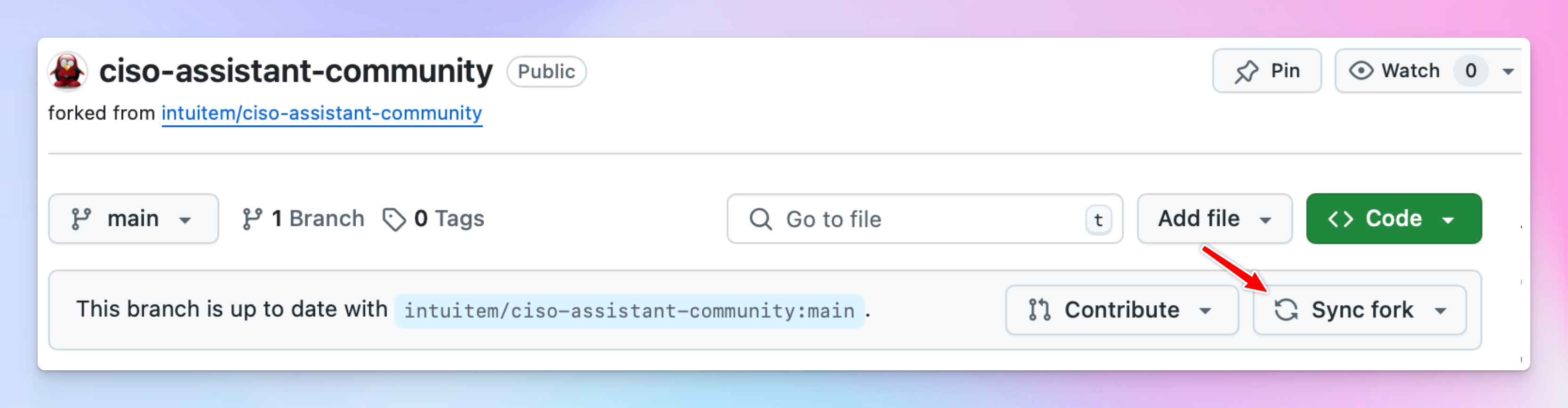
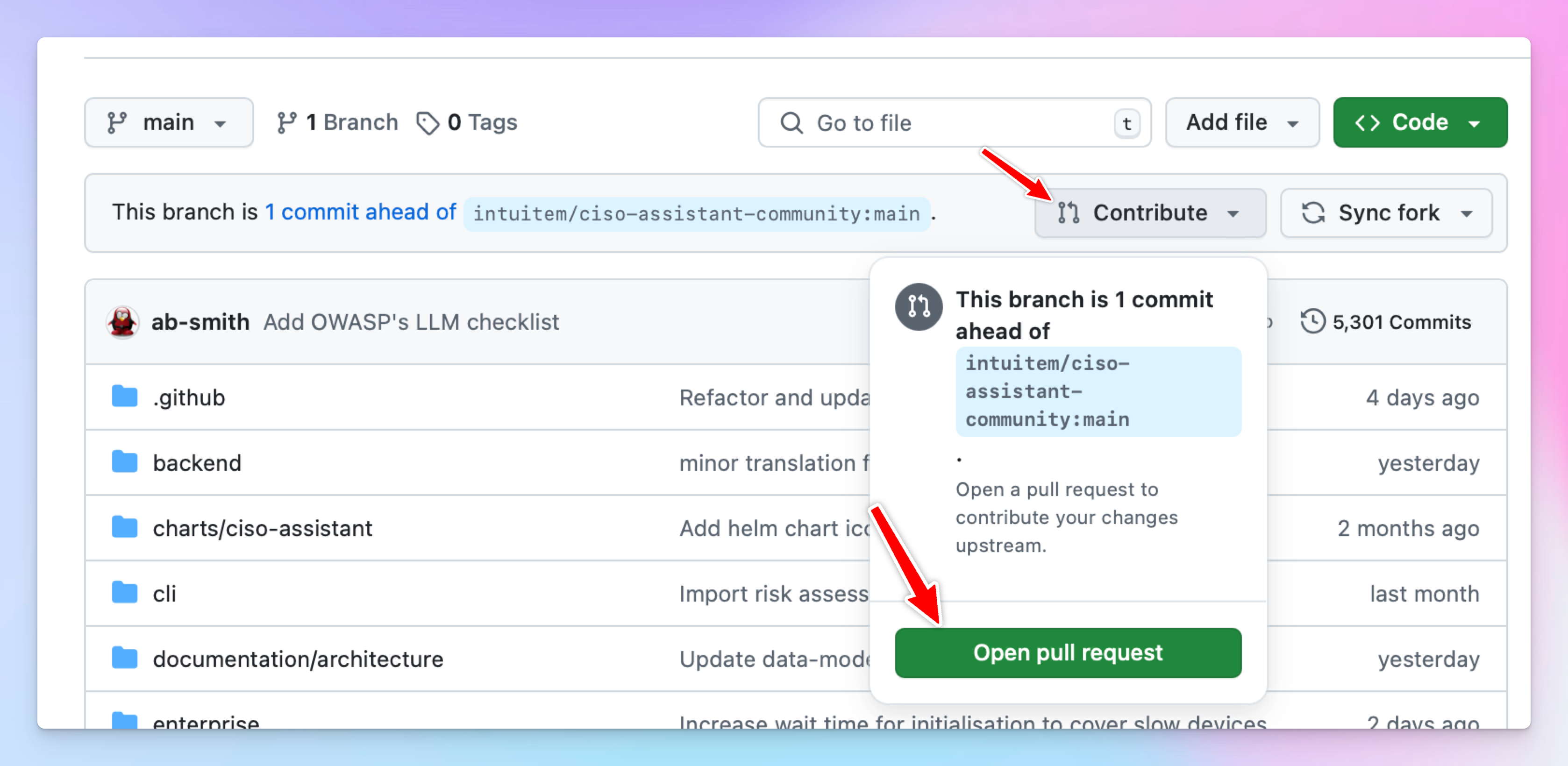
1. Fork the [community repository](https://github.com/intuitem/ciso-assistant-community) and make sure it's in sync with `main`.
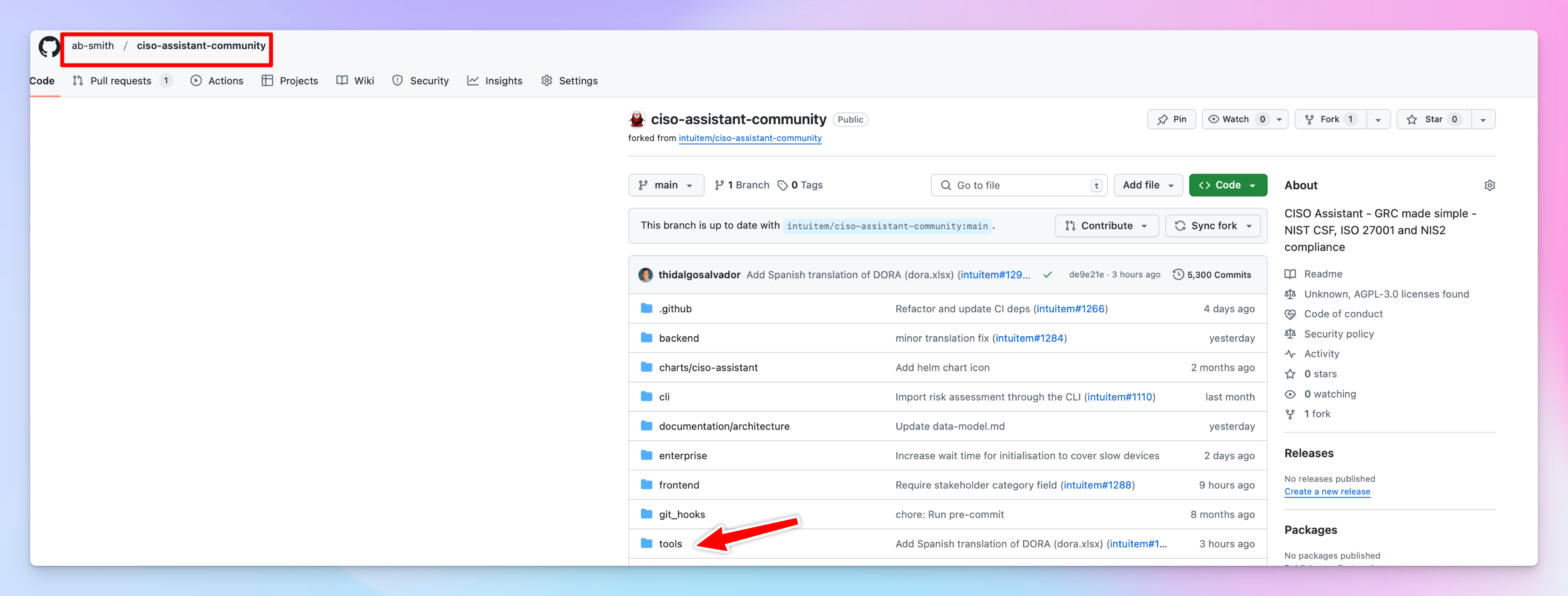
2. Add your Excel source under the `tools` folder.
3. Optionally also commit the generated YAML under `backend/library/libraries/` (only if you've tested that it loads cleanly).
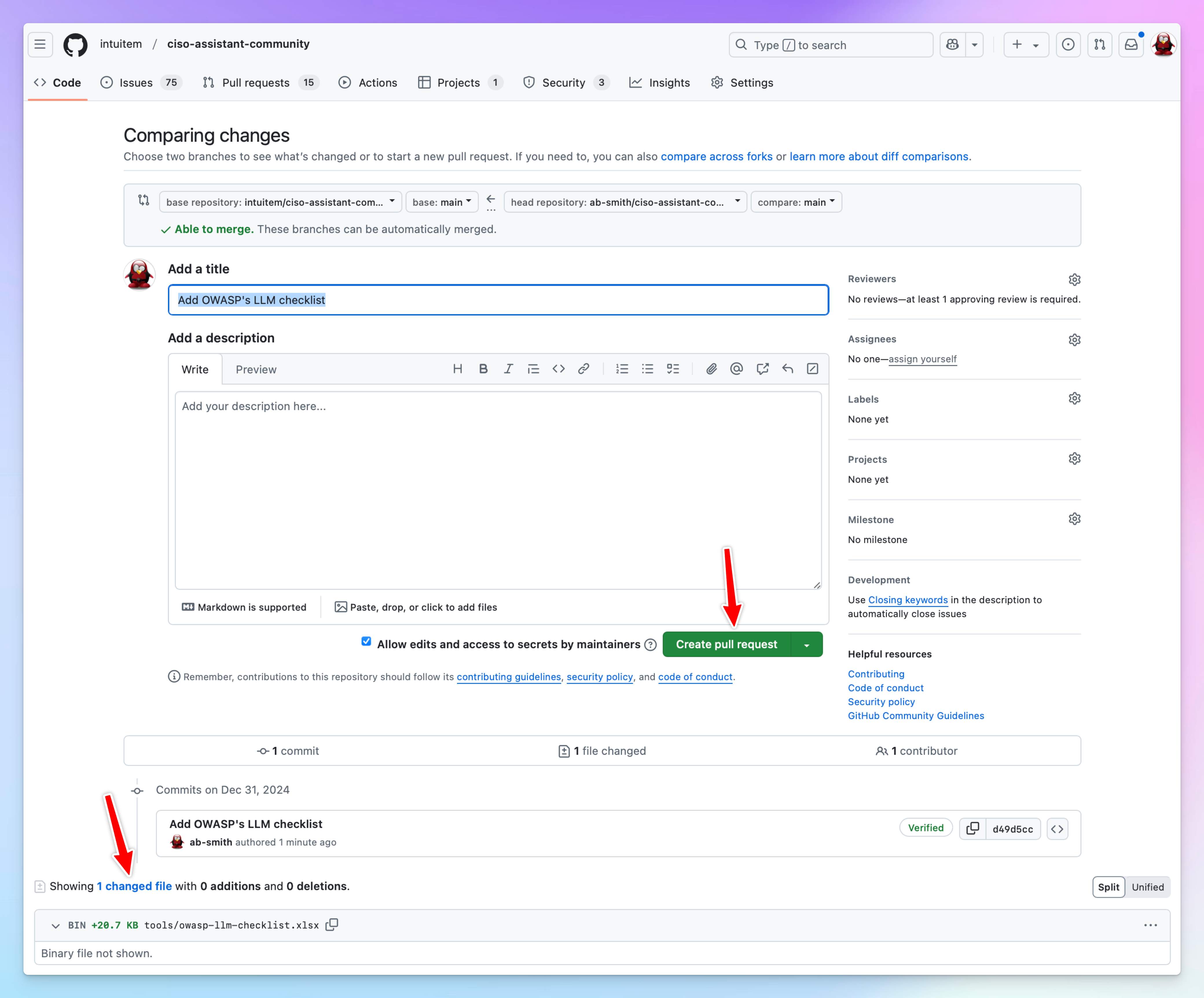
4. Open a pull request and accept the **Contributor Licence Agreement** when prompted.
We'll take it from there.
## If you'd rather use the GitHub UI
The walkthrough below uses a framework as the example, but the same flow works for matrices, threat catalogues, mappings, and reference controls.
1. **Author the Excel source.** Start from one of the samples in `tools/` (frameworks) or `tools/excel/matrix/` (risk matrices). The library type drives which sample to copy.
2. **Convert it to YAML** using the `convert_library_v2.py` tool to validate the structure end-to-end.
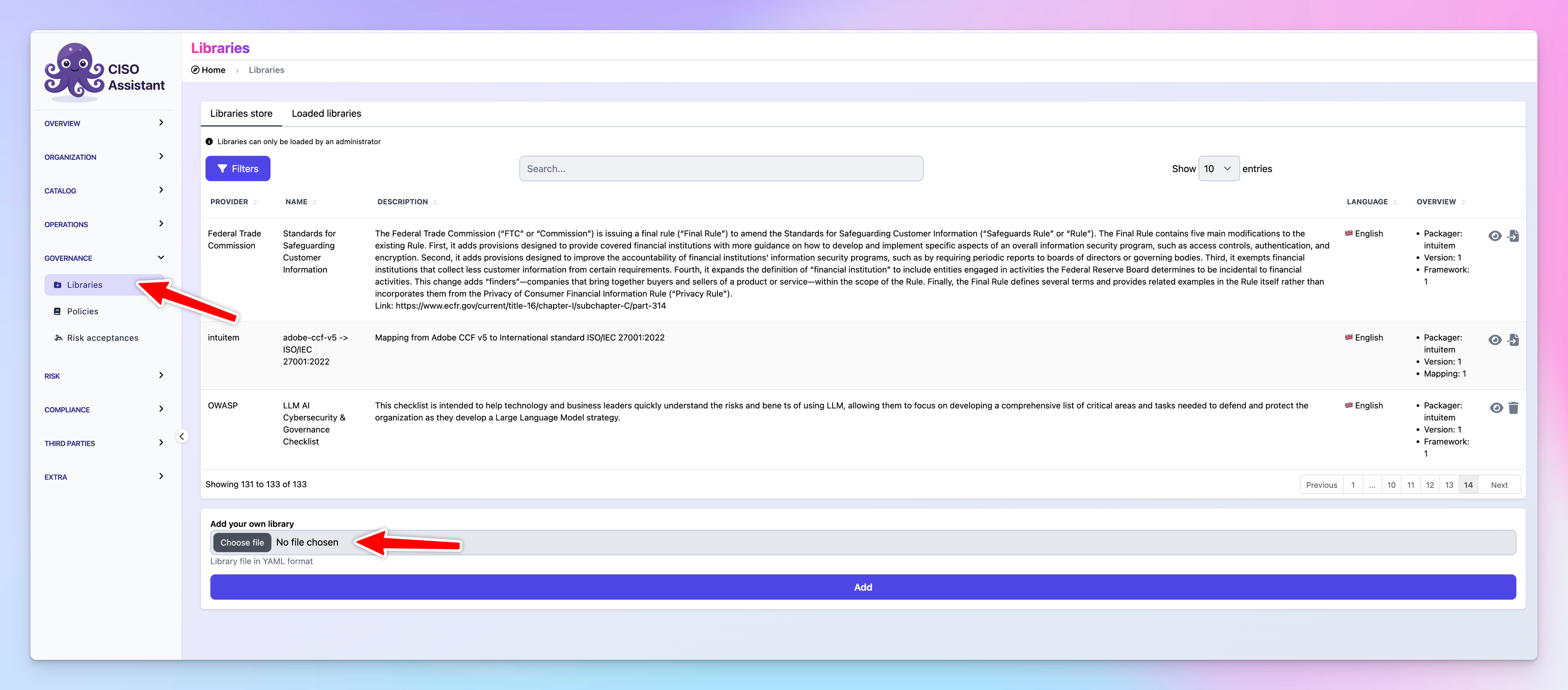
3. **Test the YAML** by loading it into a local CISO Assistant instance and checking it renders as expected.
4. **Fork the repository** on GitHub (and make sure your fork is up to date if you've contributed before).
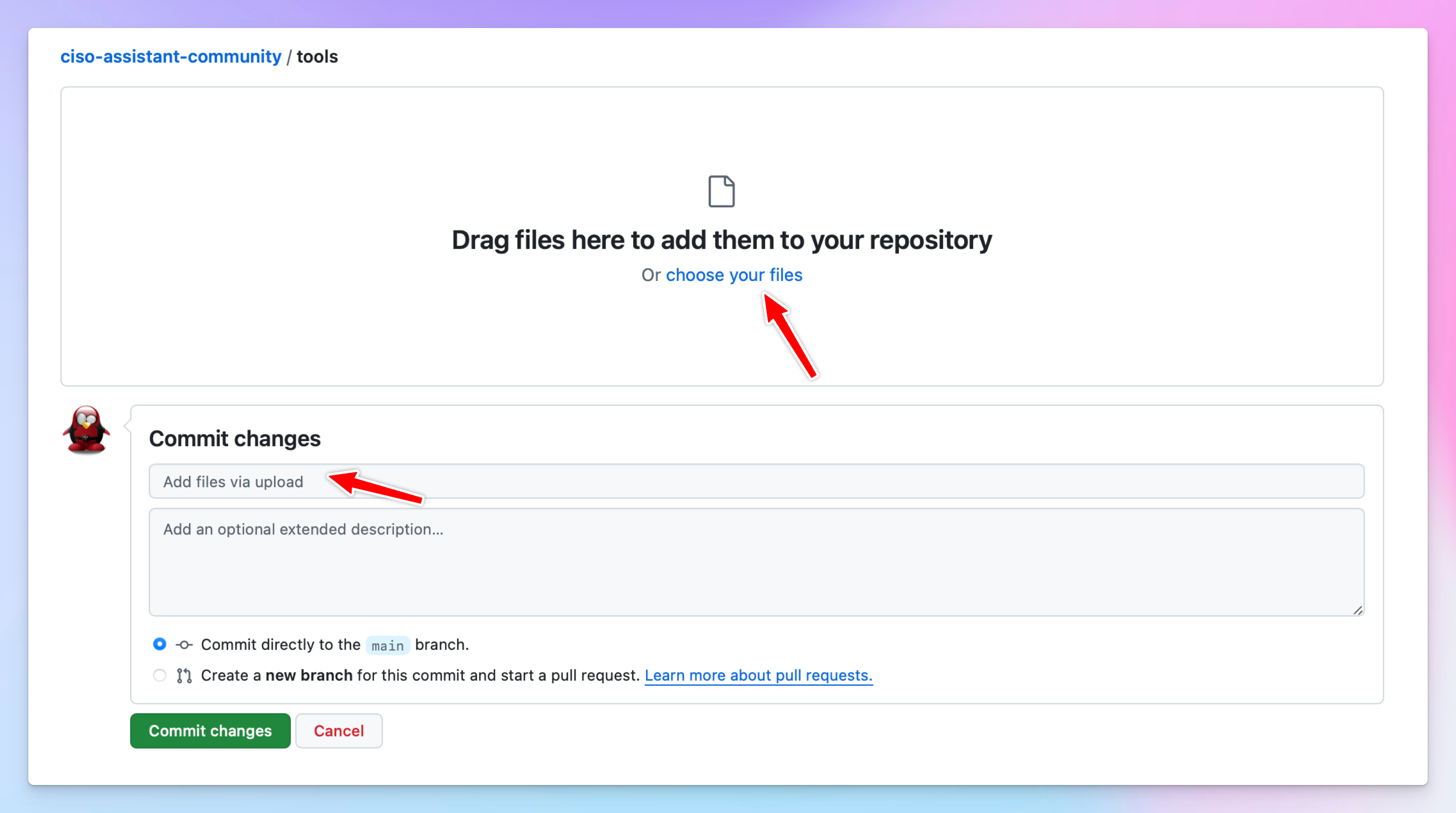
5. **Upload the Excel file** to the `tools/` folder via **Add file → Upload files**.
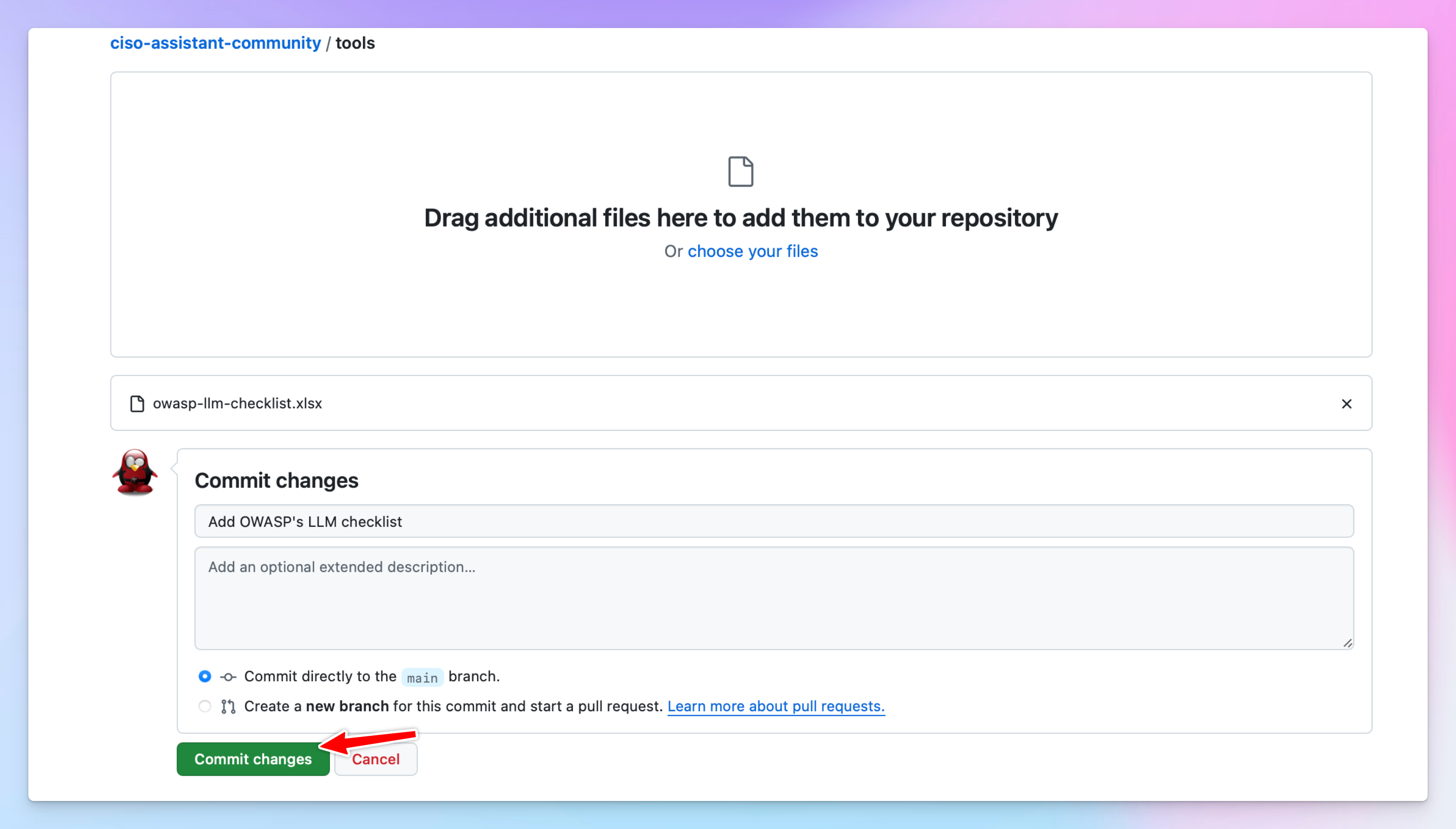
6. **Commit** with a clear message ("Submitting framework X" or "Submitting risk matrix Y").
7. **(Optional)** repeat the upload step for the YAML under `backend/library/libraries/`.
8. **Open the pull request** and accept the CLA when prompted.
## What we look for during review
* The Excel source compiles cleanly with `convert_library_v2.py`.
* URN prefixes don't collide with existing libraries.
* For frameworks: hierarchy depth stays reasonable; assessable vs structural nodes are correctly marked.
* For mappings: source and target framework URNs resolve; relationship types are valid (equal, subset, superset, intersect).
* For risk matrices: the probability/impact/risk grid is internally consistent.
* Licensing — only contribute content you're allowed to redistribute. Restrictively-licensed standards (CIS, CSA CCM) ship as converters, not bundled content.
## Related
* [Create a Library](/ciso-assistant/configuration/libraries/create-library.md)
* [Libraries concept](/ciso-assistant/concepts/catalog/libraries.md)
* [Mappings feature](/ciso-assistant/features/mappings.md)
---
# Agent Instructions
This documentation is published with GitBook. GitBook is the documentation platform designed so that both humans and AI agents can read, navigate, and reason over technical content effectively. Learn more at gitbook.com.
## Querying This Documentation
If you need additional information that is not directly available in this page, you can query the documentation by asking a question.
Perform an HTTP GET request on the following URL with the `ask` and `goal` query parameters:
```
GET https://intuitem.gitbook.io/ciso-assistant/contributing/framework.md?ask=&goal=
```
`ask` is the immediate question: it should be specific, self-contained, and written in natural language.
`goal` is what the user is ultimately trying to achieve, the reason they need the answer. Sharing it helps GitBook give you a better, more relevant answer. A goal is most helpful when it describes the outcome the user wants rather than restating the question. For example, with `ask=how do I create an API token`, a goal like `automate deployments from our CI pipeline` lets GitBook tailor the answer to that use case.
The response will contain a direct answer to the question and relevant excerpts and sources from the documentation.
Use this mechanism when the answer is not explicitly present in the current page, you need clarification or additional context, or you want to retrieve related documentation sections.
.png?alt=media)


.png?alt=media)